Sheds#
Concepts#
Sheds are an excellent opportunity for installation of solar panels, they are usually accessible, often have easy to work with structures and likely fall under some sort of permitted development. Most people focus on installing panels onto the shed roof but depending on the orientation it might be possible to install them onto the walls as well. A shed is probably the best place to start adding your solar panels.
Depending on the angle of the shed roof and the material that makes up the roof itself it would probably be acceptable to just place the panels on the roof without any particular mount to start with. A temporary solution like this allows you to test to find the best orientation and identify if there is any shading from trees or buildings nearby (remember it often doesn’t take much shading to significantly drop the output of a panel).

A small panel on a shed roof, attached to a chimney with string, credit: dtl
You’ll probably want to secure the panels down if they are going to remain up longterm such as over the winter and as shed roofs are often not particularly pitched you could probably do this with simple brackets and bolts rather than rails. Remember you’ll want to ensure any hole you make for screws or bolts are sealed up to not allow water to get through your roof into your shed. Another factor to consider is the addtional weight that the panels will add to the roof (approximately 10-20kg per m2), most well built sheds should be fine, if unsure then you could try and re-enforce the roof or get professional input.
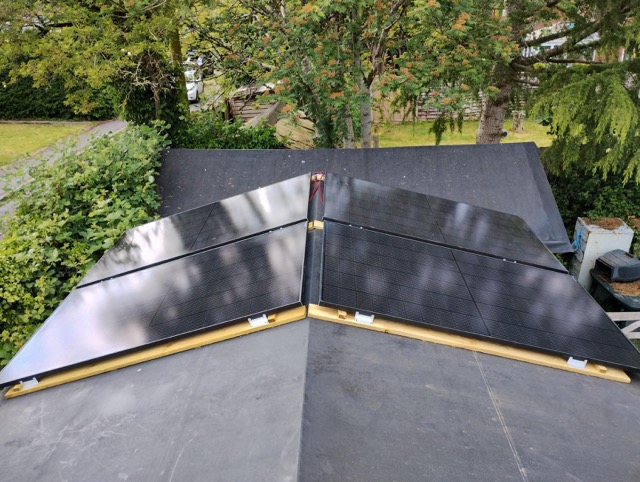
4 Ecoflow Panels on a shed roof, credit: sheddi
Apart from the roof itself there might be the option to install panels directly onto the shed wall, most sheds are wooden so it would be a matter of using simple brackets and screwing/bolting directly to the shed wall. You could also instead use the panels as a form of awning or porch.
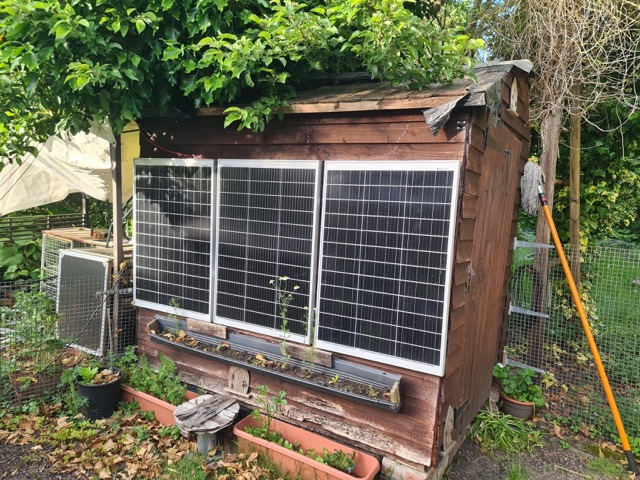
3 panels attached to the side of a shed, credit: chewie
In regards to making them stealthy, depending on the roof material using black panels and edges might help hide the panels, also often sheds aren’t particularly high and have a low pitch so are likely not going to be particularly visible from the ground or surrounding walkways.
Finally sheds are a great place to install inverters and batteries, its easy to drill holes to pass cables through particularly wooden sheds (much easier then bricks) and its possible to mount the devices on the wall and run cables. This means that you can install simple lighting such as 12V lights and run your shed off-grid. The disadvantage is that your shed might not be attached to your local grid and therefore your new shed powerhouse might not be well placed to act as plug in solar or feed into the grid.
Examples#
- Solar Shed - a commercial shed builder that integrates solar panels into the roof, they are based in UK
- Mastodon - Sheddi’s Solar Installation
- Earth Notes: Expanding and Optimising Off-grid PV for Mid-winter (2016)